Margana (मार्गणा)
Margana (मार्गणा)
- Margana means a point/aspect through which a Jiva is examined or classified.
- Jain scriptures examine a Jiva from 14 different perspectives, called 14 Mool Marganas (मूल मार्गणाएँ).
- These 14 Marganas together have 62 forms/bheda (भेद).
- The purpose is to systematically identify the state of a Jiva and then examine other details such as its location, duration, karmic condition, etc.
- The same Jiva can therefore be described through all 14 Marganas simultaneously.
14 Mool Margana classifications
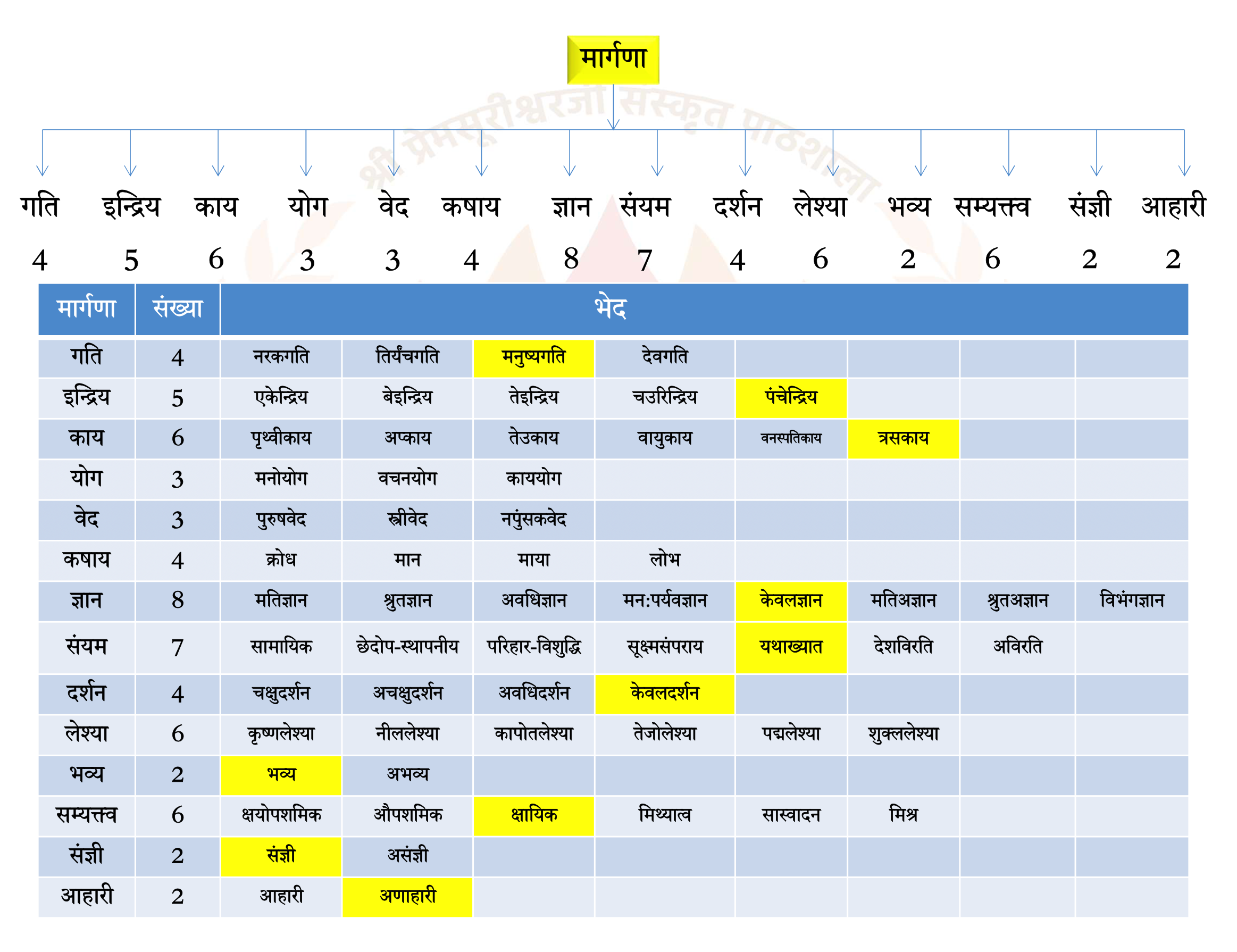
Classification
1. Gati Margana (गति मार्गणा)
- Signifier: Jiva kis Gati mein hai; i.e. which realm of existence it belongs to.
- Total: 4
- Determined by naam karma 1. Karma Types and Subtypes#6.1.1 Gati (गति) – 4
2. Indriya Margana (इन्द्रिय मार्गणा)
- Signifier: Number of senses possessed by the Jiva.
- Total: 5
- Determined by naam karma 1. Karma Types and Subtypes#6.1.2 Jati (जाति) – 5
3. Kaya Margana (काय मार्गणा)
- Signifier: Type of body (काय) possessed by the Jiva.
- Total: 6
3.1 Prithvikaya (पृथ्वीकाय)
- Signifier: Earth-bodied Jiva.
3.2 Apkaya (अप्काय)
- Signifier: Water-bodied Jiva.
3.3 Teukaya (तेउकाय)
- Signifier: Fire-bodied Jiva.
3.4 Vayukaya (वायुकाय)
- Signifier: Air-bodied Jiva.
3.5 Vanaspatikaya (वनस्पतिकाय)
- Signifier: Plant-bodied Jiva.
- Note: Includes individual and common-bodied Vanaspati.
3.6 Traskaya (त्रसकाय)
- Signifier: Mobile-bodied Jiva.
- Includes: Dvi-indriya to Panchendriya Jivas.
4. Yoga Margana (योग मार्गणा)
- Signifier: Activity or vibration of the Jiva through mind, speech and body.
- Total: 3
4.1 Mano Yoga (मनोयोग)
- Signifier: Activity through mind.
4.2 Vachan Yoga (वचनयोग)
- Signifier: Activity through speech.
4.3 Kaya Yoga (काययोग)
- Signifier: Activity through body.
- Karmic significance: Yoga is an important condition for Asrava (आस्रव).
5. Veda Margana (वेद मार्गणा)
- Signifier: Sexual disposition (वेद).
- Total: 3
5.1 Purush Veda (पुरुषवेद)
- Signifier: Male sexual disposition.
5.2 Stri Veda (स्त्रीवेद)
- Signifier: Female sexual disposition.
5.3 Napumsak Veda (नपुंसकवेद)
- Signifier: Neuter sexual disposition.
6. Kashaya Margana (कषाय मार्गणा)
- Signifier: Four principal passions that disturb the Jiva's state.
- Total: 4
6.1 Krodha (क्रोध)
- Signifier: Anger.
- Effect: Produces agitation and karmic bondage.
6.2 Mana (मान)
- Signifier: Pride / ego.
- Effect: Creates superiority-inferiority based attachment to one's status.
6.3 Maya (माया)
- Signifier: Deceit / concealment.
- Effect: Creates crookedness between inner intention and outward conduct.
6.4 Lobha (लोभ)
- Signifier: Greed / excessive acquisition.
- Effect: Keeps the Jiva attached to desired objects.
7. Jnana Margana (ज्ञान मार्गणा)
- Signifier: Type of knowledge possessed by the Jiva.
- Total: 8
7.1 Mati Jnana (मतिज्ञान)
- Signifier: Sensory-mind based knowledge.
- Basis: Indriya and mind.
7.2 Shrut Jnana (श्रुतज्ञान)
- Signifier: Knowledge based on words, signs and previously acquired knowledge.
- Relation: Develops from Mati Jnana.
7.3 Avadhi Jnana (अवधिज्ञान)
- Signifier: Direct knowledge of certain material objects beyond ordinary sensory limits.
7.4 Manahparyaya Jnana (मनःपर्ययज्ञान)
- Signifier: Direct knowledge of another Jiva's mental states.
- Level: Higher form of knowledge than Avadhi.
7.5 Kevala Jnana (केवलज्ञान)
- Signifier: Complete and unobstructed knowledge.
- State: Perfect Jnana.
7.6 Matiajnana (मतिअज्ञान)
- Signifier: Wrong knowledge corresponding to Mati Jnana.
7.7 Shrutajnana (श्रुतअज्ञान)
- Signifier: Wrong knowledge corresponding to Shrut Jnana.
7.8 Vibhanga Jnana (विभंगज्ञान)
- Signifier: Indeterminate or incomplete knowledge.
- Contrast: Not complete like Kevala Jnana.
8. Samyama Margana (संयम मार्गणा)
- Signifier: Degree and nature of restraint (संयम).
- Total: 7
8.1 Samayik (सामायिक)
- Signifier: Equanimous restraint.
- Focus: Remaining in Samata (समता).
8.2 Chedopasthapaniya (छेदोपस्थापनीय)
- Signifier: Restored monastic conduct after a transgression.
- Focus: Correction through prescribed process.
8.3 Parihar Vishuddhi (परिहार विशुद्धि)
- Signifier: Purification through special restraint and penance.
- Focus: Greater purification of conduct.
8.4 Sukshma Samparaya (सूक्ष्मसांपराय)
- Signifier: Only extremely subtle Kashaya remains.
- State: Very high level of restraint.
8.5 Yathakhyat (यथाख्यात)
- Signifier: Conduct corresponding to the Jiva's actual spiritual purity.
- State: Highest form of Charitra (चरित्र) in this classification.
8.6 Desavirati (देशविरति)
- Signifier: Partial restraint.
- State: Some activities are renounced while others remain.
8.7 Avirati (अविरति)
- Signifier: Absence of restraint.
- State: Inability to abstain from worldly activities.
9. Darshana Margana (दर्शन मार्गणा)
- Signifier: Type of Darshana (दर्शन), i.e. non-specific perception.
- Total: 4
9.1 Chakshu Darshana (चक्षुदर्शन)
- Signifier: Non-specific perception through the eye.
9.2 Achakshu Darshana (अचक्षुदर्शन)
- Signifier: Non-specific perception without the eye.
9.3 Avadhi Darshana (अवधिदर्शन)
- Signifier: Darshana associated with Avadhi.
9.4 Kevala Darshana (केवलदर्शन)
- Signifier: Perfect and unobstructed Darshana.
- State: Associated with Kevala Jnana.
10. Leshya Margana (लेश्या मार्गणा)
- Signifier: Psychic colouring or quality of the Jiva's Bhava (भाव).
- Total: 6
- Order: More impure → progressively purer.
10.1 Krishna Leshya (कृष्ण लेश्या)
- Signifier: Darkest Leshya.
- State: Highly impure Bhava.
10.2 Neel Leshya (नील लेश्या)
- Signifier: Dark blue Leshya.
- State: Impure disposition.
10.3 Kapot Leshya (कापोत लेश्या)
- Signifier: Grey/dove-coloured Leshya.
- State: Intermediate lower purity.
10.4 Tejo Leshya (तेजो लेश्या)
- Signifier: Fiery Leshya.
- State: Comparatively purer disposition.
10.5 Padma Leshya (पद्म लेश्या)
- Signifier: Lotus-coloured Leshya.
- State: Higher purity.
10.6 Shukla Leshya (शुक्ल लेश्या)
- Signifier: White Leshya.
- State: Highest degree of purity among the six Leshyas.
11. Bhavya Margana (भव्य मार्गणा)
- Signifier: Capacity of the Jiva for Moksha (मोक्ष).
- Total: 2
11.1 Bhavya (भव्य)
- Signifier: Jiva capable of attaining Moksha.
- Note: Capability does not mean immediate or guaranteed liberation.
In Jain philosophy, a Bhavya Jeev (भव्य जीव) is a soul that possesses the inherent capability or potential to attain liberation (Moksha) from the cycle of birth and death (Samsara).
The term is derived from the Sanskrit root word bhavya, which translates to "fit," "capable," or "worthy." It is a fundamental concept used in Jain metaphysics to classify souls based on their spiritual destiny.
Here is the accurate breakdown of a Bhavya Jeev according to Jain scriptural parameters:
The Core Attribute: Potential for Right Faith
- The Seed of Enlightenment: A Bhavya Jeev has the latent capacity to manifest Samyagdarshan (Right Perception/Faith), Samyagjnana (Right Knowledge), and Samyakcharitra (Right Conduct)—collectively known as the Ratnatraya (Three Jewels) required to break free from worldly bondage.
- Not Yet Liberated: Being Bhavya does not mean the soul is already liberated or even currently holy. A Bhavya Jeev can still be a worldly soul (Samsari) heavily bound by intense karmas and trapped in the lower realms (hellish or animal states) at any given moment. However, the inherent quality to eventually wake up spiritually exists within them.
The Distinction Between 'Bhavya' and 'Abhavya'
Jainism divides all living souls into two eternal, unchangeable categories based on this potential:
| Feature | Bhavya Jeev (भव्य जीव) | Abhavya Jeev (अभव्य जीव) |
|---|---|---|
| Definition | A soul capable of achieving liberation. | A soul completely incapable of achieving liberation. |
| Ultimate Destiny | Will eventually destroy all karmas and attain Moksha (with some exceptions, see below). | Will wander in Samsara (the cycle of rebirth) for eternity. |
| Spiritual Awakening | Can attain Samyagdarshan (Right Faith) when the right conditions arise. | Can never attain true Samyagdarshan, even if they practice extreme outer penance. |
The Concept of "Jati-Bhavya" (The Exception)
Jain texts introduce a nuanced sub-category within Bhavya souls known as Jati-Bhavya.
- These are souls that possess the formal structural capability for liberation, but they will never actually meet the necessary external cooperative causes (Nimitta)—such as encountering a Tirthankar's teachings—to activate that potential.
- Therefore, while they are technically Bhavya, they will remain in Samsara forever alongside the Abhavya souls.
How a Bhavya Jeev Activates Its Potential
A Bhavya Jeev transitions from a state of dormant potential to active spiritual progress by passing through specific karmic stages. As discussed previously, they must reduce their karmic load to enter the Charamavart Kaal (the final cycle of cosmic wandering). Once they cross this threshold and achieve their very first moment of self-realization (Samyagdarshan), their journey to becoming a Siddha (a liberated, pure soul) becomes absolutely guaranteed.
If you would like to explore further, let me know if you want to understand:
- The signs or characteristics (Lakshanas) by which a Bhavya Jeev can be recognized in human life.
- The concept of Abhavya Jeev in deeper detail.
- How a Bhavya Jeev triggers the Granthi Bheda (knot-breaking) of intense karmas.
Inner Inclination vs. Outer Religiosity
Jain texts explicitly differentiate between true internal spiritual inclination (Bhāv) and outer physical practice (Dravya).
- What an Abhavya can do: An Abhavya Jeev can actually possess immense scriptural intellect, study up to the 11 Angas (sacred Jain canons), take strict ascetic vows as a monk (Dravya-Lingi Muni), and perform flawless physical penances. Because of this immense meritorious action (Punya), they can be reborn in the highest heavens, such as the 9th Graiveyaka. 1
- What they lack: Despite this, their "inclination" is not truly spiritual. It is driven by a fear of hell, a desire for heavenly pleasures, or a deep-seated attachment to the rituals themselves. They completely lack Atma-Ruchi (a genuine taste or thirst for the formless soul) and Tattva-Ruchi (true love for ultimate reality). Their alignment is purely mechanical and behavioral, meaning they remain a Mithyadrishti (soul with deluded perception) at the 1st stage of spiritual development (Gunasthana). 1, 2
11.2 Abhavya (अभव्य)
- Signifier: Jiva incapable of attaining Moksha.
12. Samyaktva Margana (सम्यक्त्व मार्गणा)
- Signifier: State of Samyaktva or right belief (सम्यग्दर्शन).
- Total: 6
12.1 Kshayopashamika (क्षायोपशमिक)
- Signifier: Samyaktva through partial destruction and suppression of relevant Mohaniya Karma.
12.2 Aupashamika (औपशमिक)
- Signifier: Samyaktva through suppression of relevant Mohaniya Karma.
12.3 Kshayika (क्षायिक)
- Signifier: Samyaktva through complete destruction of Darshana Mohaniya Karma.
12.4 Mithyatva (मिथ्यात्व)
- Signifier: Wrong belief.
- State: Reality is understood in a fundamentally incorrect manner.
12.5 Sasadana (सासादन)
- Signifier: Falling state associated with loss of previously attained Samyaktva.
12.6 Mishra (मिश्र)
- Signifier: Mixed state.
- State: Right and wrong belief coexist in a mixed manner.
13. Sanjni Margana (संज्ञी मार्गणा)
- Signifier: Presence or absence of mind (मन).
- Total: 2
13.1 Sanjni (संज्ञी)
- Signifier: Jiva possessing mind (मन).
- Capacity: Able to perform mental activity.
13.2 Asanjni (असंज्ञी)
- Signifier: Jiva without mind.
- State: No developed mental faculty.
14. Ahari Margana (आहारी मार्गणा)
- Signifier: Whether the Jiva is in an Aharak (आहारक) or Anaharak (अनाहारक) state.
- Total: 2
14.1 Aharak (आहारक)
- Signifier: Ahar ग्रहण करने वाला state.
- Focus: Relationship with intake of Pudgala (पुद्गल).
14.2 Anaharak (अनाहारी)
- Signifier: Non-Aharak state.
- Focus: State in which Ahar is not being taken in.
Summary of 14 Marganas
-
Gati: 4
-
Indriya: 5
-
Kaya: 6
-
Yoga: 3
-
Veda: 3
-
Kashaya: 4
-
Jnana: 8
-
Samyama: 7
-
Darshana: 4
-
Leshya: 6
-
Bhavya: 2
-
Samyaktva: 6
-
Sanjni: 2
-
Ahari: 2
-
Total: 14 Mool Marganas with 62 subdivisions (bheda).
-
The key idea is that a Jiva can be simultaneously classified through all 14 Marganas, giving a multidimensional description of its present state.