Samyak Darshan
Tldr: Knowing true as true and false as false.
Meaning
Samyak Darshan (सम्यक् दर्शन) means right faith / right worldview: a clear and non-deluded acceptance of reality as it truly is.
It is not merely believing in Jainism intellectually. It is an inner conviction that arises when Mithyatva (मिथ्यात्व) is weakened or destroyed and the soul begins to see reality from the right perspective.
Samyak Darshan = सही वस्तु-स्वरूप में श्रद्धा
The object of this श्रद्धा is primarily the Tattva(तत्त्व) and the fundamental principles of reality.
Place in the Three Jewels
The Three Jewels (Ratnatraya / रत्नत्रय) are:
- Samyak Darshan (सम्यक् दर्शन) — Right faith / right worldview
- Samyak Gyaan (सम्यक् ज्ञान) — Right knowledge
- Samyak Charitra (सम्यक् चारित्र) — Right conduct
They are interconnected:
Darshan → Gyaan → Charitra
- Darshan: I correctly accept/recognize what reality is.
- Gyaan: I correctly know and understand it.
- Charitra: I live and act according to it.
Darshan is not "philosophy" in the ordinary sense. It is the right orientation of the soul toward reality, which then supports right knowledge and conduct.
What Samyak Darshan Is Not
Not Blind Belief
Samyak Darshan is not accepting something merely because an authority says it.
It involves श्रद्धा (shraddha) in the true nature of reality, accompanied by freedom from fundamental delusion.
Not Mere Intellectual Agreement
Someone can understand Jain philosophy intellectually yet remain attached to wrong worldviews.
Therefore:
Knowing a doctrine ≠ having Samyak Darshan
Not Complete Knowledge
Samyak Darshan does not mean knowing everything.
A person can possess Samyak Darshan with limited knowledge.
This is why the Three Jewels are distinct.
It is Opposite of Mithyatva
Mithyatva (मिथ्यात्व) = wrong worldview / deluded faith.
It causes reality to be misunderstood or incorrectly valued.
| Mithyatva | Samyak Darshan |
|---|---|
| Wrong orientation toward reality | Right orientation toward reality |
| Tattvas are misunderstood/rejected | Tattvas are accepted correctly |
| Deluded श्रद्धा | Right श्रद्धा |
| Supports bondage | Supports the path toward liberation |
- Samyak Darshan does not mean that all doubts disappear.
- It means the fundamental direction of one's worldview has shifted from mithya to samyak.
Object of Samyak Darshan
Samyak Darshan involves श्रद्धा in the fundamental truths of Jain philosophy, especially the **Tattva(तत्त्व)
For example:
- The soul is understood as fundamentally distinct from the body.
- External objects are understood as Ajiva, not the soul.
- Attachment and aversion are recognized as causes of karmic influx.
- Liberation is understood as the natural perfected state of the soul.
- External circumstances are no longer treated as the ultimate source of inner freedom.
Samyak Darshan and Kashaya
The fundamental obstacle to Samyak Darshan is Mithyatva Mohniye Karm
Mohaniya Karma (मोहनीय कर्म) deludes the soul's worldview and conduct.
Broadly:
- Darshan Mohaniya → distorts faith/worldview
- Charitra Mohaniya → distorts conduct through passions
Therefore, Samyak Darshan represents a major shift in the operation of Darshan Mohaniya Karma.
Position in Gunsthan
- These stages lack Samyak Darshan:
- Samyak Darshan Begins at 4. Avirat Samyag Drishti
- Right vision arises
- Truth becomes internally clear
- But conduct is still not fully disciplined
- This is the true spiritual turning point.
Gunasthanas are the progressive refinement of Samyak Darshan, knowledge, and conduct.
Three Main Types of Samyak Darshan
1. Upshamik Samyak Darshan
Right faith arises through
- temporary suppression/Upsham of Mithyatva, Misra and Samyaktva Mohniye Karm
- And suppression of 4 Anantanubandhis such that they do not undergo Rasoday and only undergo Pradeshoday
That means when all 7 of these major karma are not active(despite being in satta ) then it is called upshamik Samyak Darshan.
Nature
- Delusion still exists underneath
- Spiritual clarity is temporary
- Fall back is possible
Analogy
Clouds temporarily move away from the sun.
Relation to Guṇasth ana
- Often associated with early emergence of right faith
- Can occur around the 4th stage
- Spiritually unstable
2. Kshayopshamik Samyak Darśan
Right faith arises through:
Nature
- More stable
- Most common type among progressing seekers
- Core worldview changes permanently
Analogy
Some clouds destroyed, remaining clouds temporarily cleared.
Relation to Guṇasth ana
- Supports sustained progress from 4th onward
- Common across many middle spiritual stages
3. Kshayik Samyak Darśan
Meaning
Right faith that arises through complete destruction of Mithyatva, Misra and Samyaktva Mohniye Karm, Anantanubandhi Krodh, Maan, Maya and Lobh
Nature
- Irreversible
- No return to wrong belief possible
- Extremely advanced state
Analogy
Clouds permanently disappear.
Relation to Guṇasthanas
- Associated with very advanced purification
- Especially near 12th stage and beyond
4. Vedaka Samyak Darśan
Meaning
Vedaka Samyaktva (वेदक सम्यक्त्व) is the transitional form of Kshayopshamika Samyaktva that occurs when the soul is moving toward Kshayik Samyaktva.
The defining idea is:
The soul has Kshayopshamika Samyaktva, but is now progressing toward complete destruction of the Darśana Mohaniya karmas and Anantanubandhi Kashayas.
"Vedaka" is associated with vedana / experiencing the fruition of the relevant karmic configuration and, in some traditional presentations, with the soul being on the way to the destruction of Samyag-Mithyatva.
Karmic Basis
Vedaka Samyaktva involves the relevant Kshayopsham of:
-
[Mithyatva Mohaniya](Karma Types and Subtypes#4.1.1 Mithyatva (मिथ्यात्व) Mohaniya)
-
[Samyag-Mithyatva / Misra Mohaniya](Karma Types and Subtypes#4.1.2 Samyag-Mithyatva (सम्यग्मिथ्यात्व) Mohaniya)
-
the four Anantanubandhi Kashayas:
-
Anantanubandhi Krodha
-
Anantanubandhi Mana
-
Anantanubandhi Maya
-
Anantanubandhi Lobha
-
while Samyaktva Mohaniya remains in Uday.
The crucial point is that this is still not Kshayik Samyaktva.
What is happening?
Conceptually:
Kshayopshamika Samyaktva
          │
          │ further purification
          ▼
     Vedaka Samyaktva
          │
          │ destruction of remaining
          │ relevant deluding karma
          ▼
      Kshayik Samyaktva
Therefore:
Vedaka = bridge toward Kshayik Samyaktva
It is not a completely independent permanent form of Samyaktva.
Nature
-
Extremely transitional
-
Represents a decisive movement toward permanent Samyaktva
-
The relevant karmic obstruction is being destroyed rather than merely suppressed
-
It is followed by Kshayik Samyaktva
-
Unlike Aupashamika Samyaktva, the direction is upward toward destruction, not merely temporary suppression
Analogy
Imagine a room covered by a layer of dust.
-
Aupashamika → dust is temporarily pushed aside
-
Kshayopshamika → some dust is removed and some is temporarily cleared
-
Vedaka → the remaining obstruction is actively being eliminated
-
Kshayika → the relevant dust is completely removed
Relation to Guṇasthāna
Vedaka Samyaktva is associated with the soul's movement toward Kshayik Samyaktva through the higher stages of spiritual development.
Traditional explanations place this transition in the higher Guṇasthānas, particularly around the 8th–10th stages, depending on the specific doctrinal framework being used.
Key Distinction
Do not memorize:
Vedaka = another permanent kind of Samyaktva
Better:
Vedaka = a transitional Kshayopshamika Samyaktva leading toward Kshayik Samyaktva.
5. Sāsvādana Samyak Darśan
Meaning
Sāsvādana (सास्वादन) literally conveys the idea of "tasting".
It refers to the extremely brief residual taste of Samyaktva that remains when a soul possessing right faith is falling downward toward Mithyatva.
Therefore:
Sāsvādana = residual taste of right faith during a fall.
It is fundamentally different from Vedaka.
How does it arise?
Consider a soul possessing Aupashamika Samyaktva.
Its right faith exists because the relevant deluding karmas are suppressed (Upasham).
If the suppressed Anantanubandhi Kashayas rise again, the soul begins falling.
The sequence can be conceptualized as:
Aupashamika Samyaktva
        │
        │ Anantanubandhi Kashayas arise
        ▼
   Sāsvādana state
        │
        │ continued fall
        ▼
   Mithyatva
The soul is therefore losing Samyaktva, not acquiring it.
Why is it called "Samyaktva"?
This is where the terminology can be misleading.
Sāsvādana is called Samyaktva because the soul still has a residual taste/trace of the previously possessed right faith.
It should not be interpreted as:
"The soul has fully functioning right faith."
Instead:
The soul is in the process of losing right faith but has not yet completely reached Mithyatva.
Karmic Trigger
The critical event is the rise of the four Anantanubandhi Kashayas:
-
Krodha
-
Mana
-
Maya
-
Lobha
These had been suppressed in the Aupashamika state.
When they rise:
Suppression breaks → Samyaktva collapses → Sāsvādana → Mithyatva
This is why Anantanubandhi Kashaya is central to understanding Sāsvādana.
Nature
-
Extremely fleeting
-
Transitional
-
Downward-moving
-
Not a stable spiritual attainment
-
Represents the last residual taste of right faith
-
Followed by Mithyatva if the fall continues
Analogy
Imagine drinking something sweet.
The drink is gone, but a faint sweetness remains on the tongue.
That remaining sweetness is Sāsvādana.
Similarly:
Samyaktva is being lost, but its taste has not yet completely disappeared.
Relation to Guṇasthāna
Sāsvādana corresponds specifically to the 2nd Guṇasthāna: Sāsvādana Guṇasthāna.
The soul is falling from a higher state toward Mithyātva Guṇasthāna (1st). Traditional explanations describe it as an extremely brief intermediate state.
Critical Distinction from Vedaka
| Vedaka | Sāsvādana | |
|---|---|---|
| Direction | Upward | Downward |
| What is happening? | Moving toward permanent Samyaktva | Losing Samyaktva |
| Relation to Kshayik | Leads toward Kshayik | Moves away from Samyaktva |
| Main karmic context | Further destruction of deluding karma | Rise of suppressed Anantanubandhi Kashayas |
| Character | Transitional purification | Residual taste |
| Guṇasthāna context | Higher stages during ascent | 2nd Guṇasthāna |
| Duration | Extremely brief | Extremely brief |
| Analogy | Cleaning the remaining obstruction | Lingering taste after the substance is gone |
Fivefold Classification of Samyaktva
The traditional fivefold classification can therefore be understood much better as:
| Type | Core mechanism | Direction |
|---|---|---|
| Aupashamika | Upasham of deluding karma | Temporary right faith |
| Kshayopshamika | Kshay + Upasham | Partially purified right faith |
| Kshayika | Complete Kshay | Permanent right faith |
| Vedaka | Transitional Kshayopshamika state moving toward Kshayika | Upward transition |
| Sāsvādana | Residual taste during loss of right faith | Downward transition |
This explains why simply memorizing "five types" is misleading.
The first three describe the basis/state of Samyaktva, while the latter two are better understood as transitional conditions associated with movement between states. Sources differ somewhat in how they classify Vedaka and Sāsvādana, but this distinction is useful for keeping the Guṇasthāna logic straight.
The Complete Samyaktva Journey
A useful conceptual map is:
                    MITHYATVA
                       │
                       │ spiritual awakening
                       ▼
             ┌────────────────────┐
             │ Samyaktva arises   │
             └────────────────────┘
                       │
          ┌────────────┼────────────┐
          │            │            │
          ▼            ▼            ▼
    Aupashamika   Kshayopshamika   Kshayika
    temporary       mixed basis    permanent
          │            │
          │            │
          │            ▼
          │         VEDAKA
          │            │
          │            ▼
          │       Kshayika
          │
          │ Anantanubandhi
          │ Kashayas rise
          ▼
      SASVADANA
          │
          │ continued fall
          ▼
       MITHYATVA
The key asymmetry is:
Vedaka is an upward transition toward Kshayik Samyaktva.
Sāsvādana is a downward transition away from Samyaktva toward Mithyatva.
The Role of Anantanubandhi Kashaya
The four Anantanubandhi Kashayas are particularly important because they sit at the boundary between Samyaktva and Mithyatva.
Anantanubandhi Kashaya suppressed
                │
                ▼
       Samyaktva possible
                │
                │ if suppression breaks
                ▼
Anantanubandhi Kashaya rises
                │
                ▼
          Sāsvādana
                │
                ▼
          Mithyatva
This is especially important for understanding Aupashamika Samyaktva.
Aupashamika Samyaktva can be lost because its foundation is Upasham, not complete Kshay.
Therefore:
What is suppressed can rise again.
By contrast:
Anantanubandhi + Darshana Mohaniya
             │
       complete Kshay
             ▼
       Kshayika Samyaktva
             │
        irreversible
This is the fundamental difference between the two paths.
A Better Mental Model
Do not think of the five names as five unrelated "types of belief."
Think of them as different karmic configurations of Samyagdarśana:
                    SAMYAGDARSHAN
                         │
          ┌──────────────┼──────────────┐
          │              │              │
       How it arises?  How stable?   Where is it going?
          │              │              │
     Upasham/Kshay     Temporary/      ↑ Vedaka
     /Kshayopsham      Permanent       ↓ Sāsvādana
          │
     ┌────┼─────┐
     ▼    ▼     ▼
   Aupa  Kshay  Kshayopsham
The most important conceptual distinction is:
Aupashamika, Kshayopshamika and Kshayika describe the karmic basis of right faith. Vedaka and Sāsvādana describe transitional situations associated with the soul's movement toward or away from it.
Core Spiritual Structure
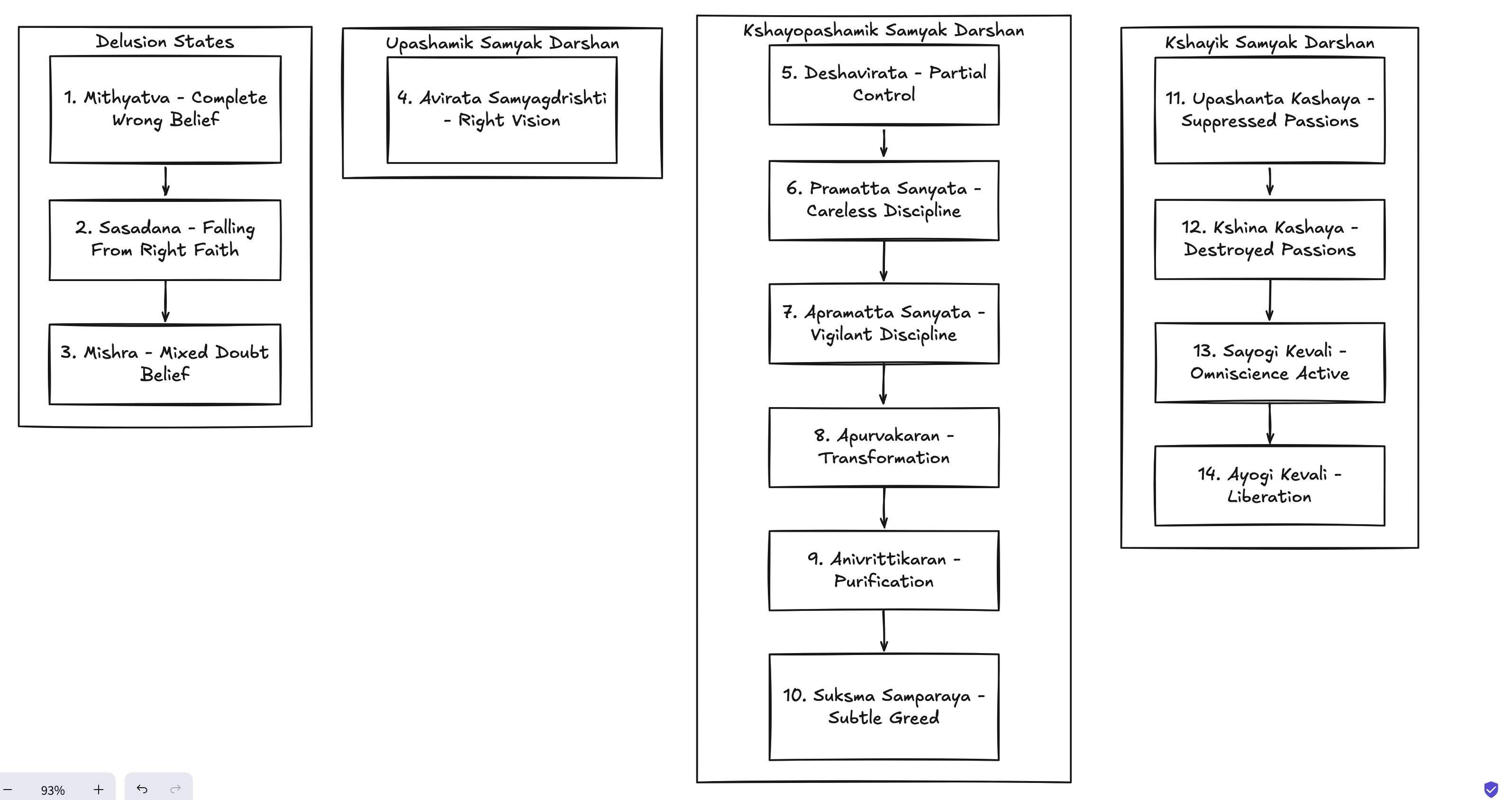
The entire spiritual ascent works like this:
flowchart TD

subgraph A["Delusion States"]
A1["1. Mithyatva - Complete Wrong Belief"]
A2["2. Sasadana - Falling From Right Faith"]
A3["3. Mishra - Mixed Doubt Belief"]
A1 --> A2 --> A3
end

subgraph B["Upashamik Samyak Darshan"]
B1["4. Avirata Samyagdrishti - Right Vision"]
end

subgraph C["Kshayopashamik Samyak Darshan"]
C1["5. Deshavirata - Partial Control"]
C2["6. Pramatta Sanyata - Careless Discipline"]
C3["7. Apramatta Sanyata - Vigilant Discipline"]
C4["8. Apurvakaran - Transformation"]
C5["9. Anivrittikaran - Purification"]
C6["10. Suksma Samparaya - Subtle Greed"]
C1 --> C2 --> C3 --> C4 --> C5 --> C6
end

subgraph D["Kshayik Samyak Darshan"]
D1["11. Upashanta Kashaya - Suppressed Passions"]
D2["12. Kshina Kashaya - Destroyed Passions"]
D3["13. Sayogi Kevali - Omniscience Active"]
D4["14. Ayogi Kevali - Liberation"]
D1 --> D2 --> D3 --> D4
end

A3 --> B1
B1 --> C1
C6 --> D1
Simplest Essence
| Concept | Essence |
|---|---|
| Samyak Darśan | Seeing truth correctly |
| Guṇasth anas | Levels of purification after/right around that awakening |
| Upshamik | Temporary clarity |
| Kshayopshamik | Partly permanent clarity |
| Kshayik | Completely irreversible clarity |
Final One-Line Insight
Samyak Darśan is the doorway to liberation, and the Guṇasth anas describe how that right vision gradually stabilizes, purifies, perfects, and finally culminates in omniscience and moksha.